TIFF Review: The Golden Era
Directed by Ann Hui • 2014 • 178 Min • in Mandarin with English subtitles
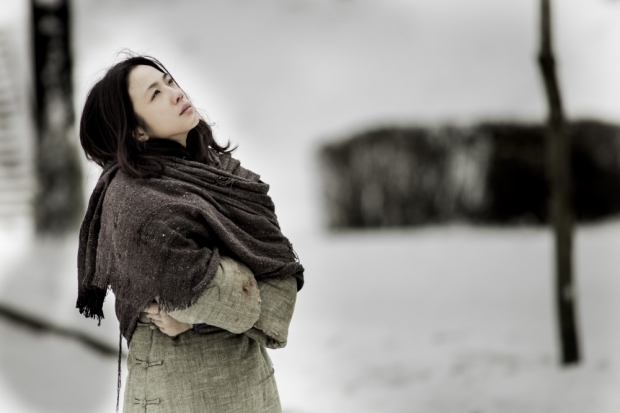
After playing at Cannes and the Venice International Film Festival, Ann Hui’s The Golden Era thankfully gets a North American premiere courtesy of the Toronto International Film Festival. In Hui’s tragic tale, the life and career of acclaimed Chinese poet and novelist Xiao Hong (played by Tang Wei) are presented through a reflexive style that provides both a clear narrative and a challenge to the edict that an individual’s life and experience can ever be truly known (or shown).
In the mid-twentieth century, Xiao Hong leaves home to escape an oppressive family life and looming arranged marriage. Shunned for her sexual indiscretions and unexpected pregnancy, she struggles further when a lover leaves her stranded in their hotel room, unable to pay an outrageous bill. Threatened with being sold to a brothel to pay her debts, Xiao reaches out to a group of Leftist writers who instantly recognize her talents as a poet and are incensed by the injustice that she faces. Her freedom restored, Xiao continues her writing and develops friendships and romances with members of the growing Chinese Left. Seemingly unsatisfied in her relationships, Xiao soon succumbs to tuberculosis at the young age of thirty-one.
Xiao’s early death looms over The Golden Era, an inevitable spectre revealed to us in the film’s opening monologue, delivered through direct address in black & white by an already deceased Xiao. This scene is only the first of many that signal something other than the typical biopic approach of Hollywood. Frequently, characters look knowingly into the camera or speak in seeming soliloquies entirely separate from the main action. In a few especially evocative moments, passages from Xiao Hong’s poems are superimposed over scenes, read aloud by Xiao, reminding us that this is not Xiao Hong’s life but a subjective extrapolation from works that may provide insight into the author’s life.
One has the sense that knowledge of Xiao Hong’s oeuvre would provide welcome insight into some of Hui’s directorial choices. References to Xiao’s emotional state when writing poems with titles like “Foundling” and “The Orphan” seem too easily attributed to the child she gave up for adoption, or another deceased in infancy. It is difficult to forget, after all, that Xiao was shunned by her own parents and found a new surrogate family in her fellow writers. Similarly, in a rather long interlude where Xiao is almost completely silent, listening passively to the philosophies of the men in her life, the author appears to suffer from severe depression. Does this correspond to a particularly fallow period in her writing? The film is enigmatic in these ways, while encouraging us to look to the source texts for elaboration.
While the film would benefit from slightly tighter pacing, it is a beautiful exercise in subjective representation. While Hui attempts to provide a cohesive picture of who Xiao Hong was, she never claims authority or denies her own acts of interpretation. This is not only refreshingly honest, but also provides us with a complex tale that forces further contemplation on the life and work of Xiao Hong and on the sources of knowledge and understanding.
The Golden Era will be playing at the TIFF Bell Lightbox Cinema on Sunday, September 14th at 11:45 am.